8.3. TEval
The TEval abstract class defines the interface of user evaluation model. It provides an user class
basis to define a model, and allows composition class to combine models together.
A standard evaluation is a function from \(n\) input parameters to \(m\) output parameters. \(n\) and \(m\)
are known and fixed during the run, but they can now be string, vectors, or double. These evaluations
may not return a value. Generally, it is due to an inconsistent input set. TMaster may support (or
not) this lack.
A glimpse of all the assessor classes available can be found in Figure 8.2 that
displays the hierarchy of class starting from the inheritance of TEval.
Figure 8.2 Hierarchy of classes and structures for the evaluation part of the Relauncher module.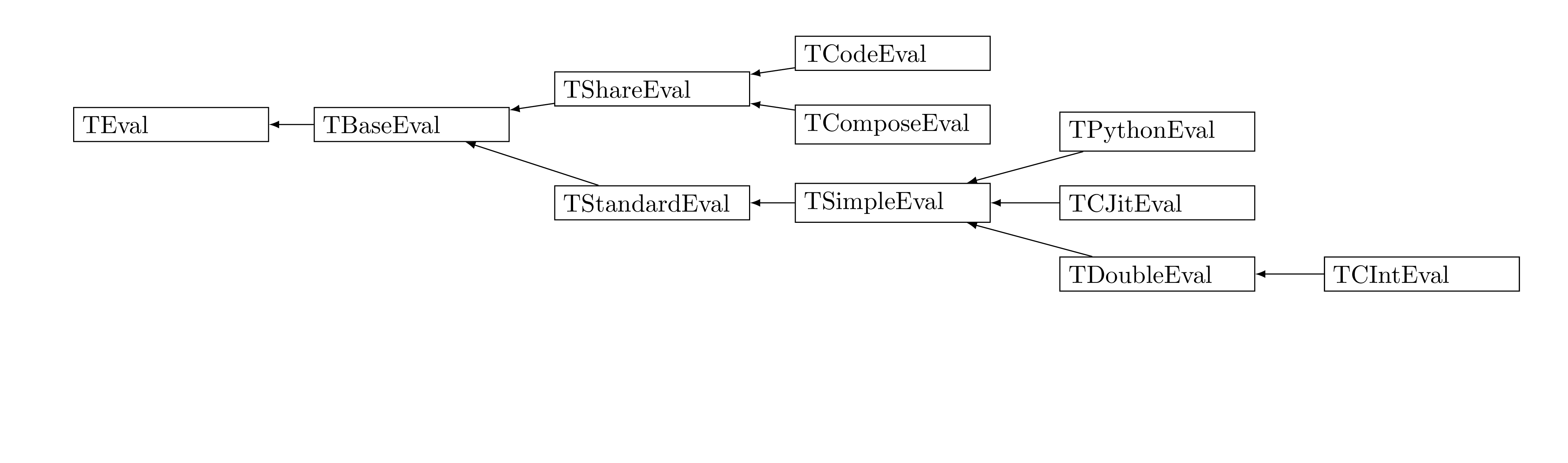
All the assessors will need to have attributes attached to them, both inputs and outputs. Input attributes might have a peculiar status, by being constant disregarding the provided stochastic law. On the other hand, output attributes might be considered temporary if, for instance, their value is of no interest for the final analysis but might be used by another assessor in composition. All this is discussed later on, in TMaster as these specification will be done directly on the master object.