2.1.1.19. Composing law
It is possible to imagine a new law, hereafter called composed law, by combining different pre-existing laws in order to model a wanted behaviour. This law would be defined with \(N\) pre-existing laws whose densities are noted \(\lbrace f_j\rbrace_{1\leq j \leq N }\), along with their relative weights \(\lbrace \omega_j\rbrace_{1\leq j \leq N } \in (\mathbb{R}^{+})^{N}\) and the resulting density is then written as
The mean value of this newly generated law can be expressed, assuming that all pre-existing laws have a finite
and defined expectation denoted \(\lbrace \mu_j\rbrace_{1\leq j\leq N }\), as \(\mu = \sum_{j=1}^{N}\frac{\omega_j \mu_j}{S}\)
where the sum of all weights is \(S = \sum_{j=1}^{N} \omega_j\). As for the mean value, the variance of this newly generated
law can be expressed, assuming that all pre-existing laws have a finite and defined expectation and variance, as done below in a very generic way.
In the case of unweighted composition, this can be written as \(\displaystyle{\rm Var}_f = \frac{1}{N}\sum^{N}_{j=1} \sigma^2_j + \frac{N-1}{N^2} \sum^{N}_{j=1} \mu_j^2 - \frac{2}{N^2} \sum_{1\leq i < j \leq N} \mu_i\mu_j\) .
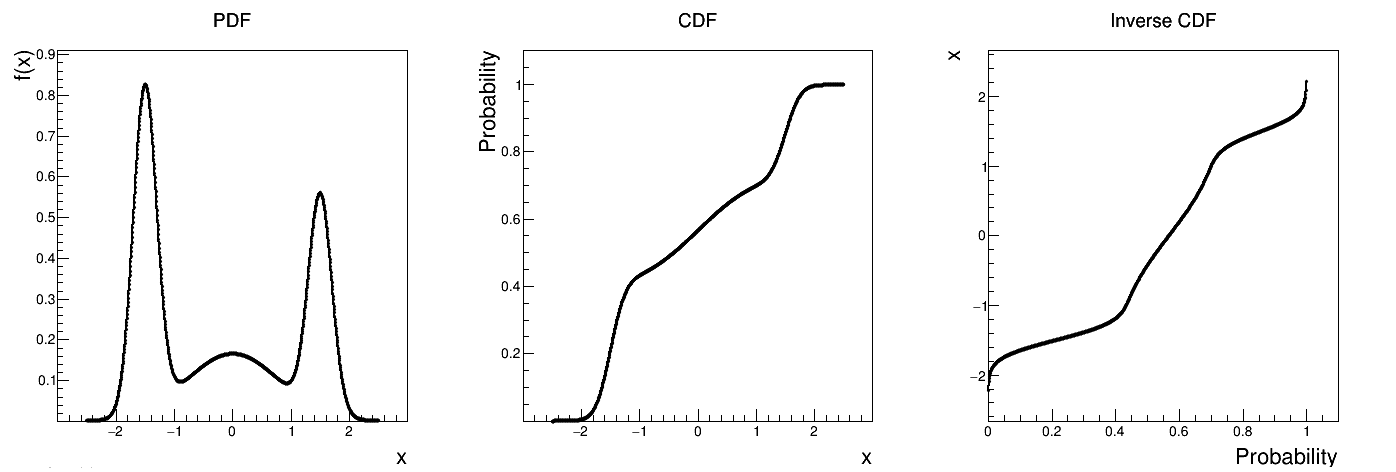
Figure 2.20 shows the PDF, CDF and inverse CDF generated for different sets of parameters.
Figure 2.20 Example of PDF, CDF and inverse CDF for a composed distribution made out of three normal
distributions with respective weights.