2.1.1.12. Weibull law
This law describes a weibull distribution depending on the location \(x_{\rm min}\), the scale \(\lambda\) and the shape \(k\), as
\[f(x) = \frac{k}{\lambda} \times\left(\frac{x-x_{\rm min}}{\lambda}\right)^{k-1}
\times e^{-\left(\frac{x-x_{\rm min}}{\lambda}\right)^{k}} \;
{\rm1\kern-0.28emI}_{[x_{\rm min},+\infty[}(x)\]
The mean value of the Weibull law can then be computed as \(\mu = \lambda\Gamma(1+1/k)+x_{\rm min}\) while its variance can be written as \(\sigma^2=\lambda[\Gamma(1+2/k)-(\Gamma(1+1/k))^{2} ]\).
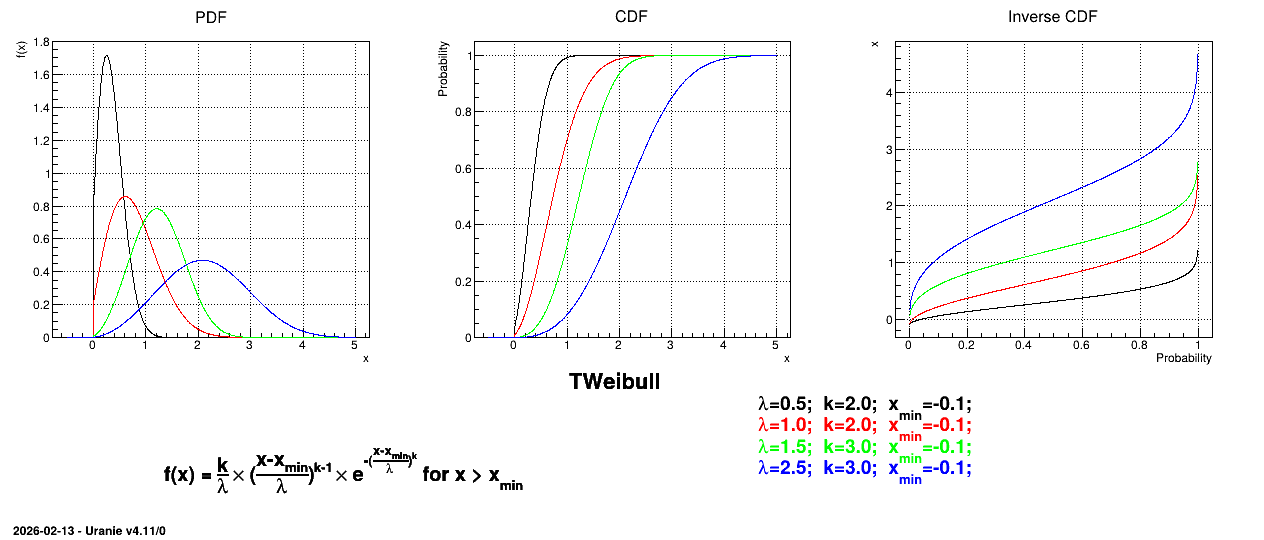
Figure 2.13 shows the PDF, CDF and inverse CDF generated for different sets of parameters.
Figure 2.13 Example of PDF, CDF and inverse CDF for Weibull distributions.