13.8.3. Macro “reoptimizeHollowBarCodevizir.C”
13.8.3.1. Objective
The objective of the macro is to optimize the section and distortion of the hollow bar defined in
Sizing of a hollow bar example problem using the evolutionary solvers. This can be done with
different solvers, the one chosen here being the TVizirGenetic one.
13.8.3.2. Macro Uranie
using namespace URANIE::DataServer;
using namespace URANIE::Relauncher;
using namespace URANIE::Reoptimizer;
    // variables
    TAttribute x("x", 0.0, 1.0),
      y("y", 0.0, 1.0),
      thick("thick"), // thickness
      sect("sect"), // section of the pipe
      dist("dist"); // distortion
// Creating the TCodeEval, dumping output of the dummy python in an output file
string python_exec = "python3";
if(string(gSystem->GetBuildArch()) == "win64")
python_exec.pop_back();
TCodeEval code((python_exec + " bar.py > bartoto.dat").data());
// Pass the python script itself as a input file. x and y will be modified in bar.py directly
TKeyScript inputfile("bar.py");
inputfile.addInput(&x,"x");
inputfile.addInput(&y,"y");
code.addInputFile(&inputfile);
// precise the name of the output file in which to read the three output variables
TFlatResult outputfile("bartoto.dat");
outputfile.addOutput(&thick);
outputfile.addOutput(§);
outputfile.addOutput(&dist);
code.addOutputFile(&outputfile);
// Create a runner
TSequentialRun runner(&code);
runner.startSlave(); // Usual Relauncher construction
if(runner.onMaster())
{
// Create the TDS
TDataServer tds("vizirDemo", "Param de l'opt vizir pour la barre");
tds.addAttribute(&x);
tds.addAttribute(&y);
        // create the vizir genetic solver
        TVizirGenetic solv;
        // Set the size of the population to 150, and a maximum number of evaluation at 15000
        solv.setSize(200,15000);
// Create the multi-objective constrained optimizer
TVizir2 opt(&tds, &runner, &solv);
// add the objective
opt.addObjective(§); // minimizing the section
opt.addObjective(&dist); // minimizing the distortion
// and the constrains
TGreaterFit positiv(0.4);
opt.addConstraint(&thick,&positiv); //on thickness (thick > 0.4)
opt.solverLoop(); // running the optimization
// Stop the slave processes
runner.stopSlave();
TCanvas *fig1 = new TCanvas("fig1","Pareto Zone",5,64,1270,667);
int phi=12; int theta=30;
TPad *pad1 = new TPad("pad1","",0,0.03,1,1);
TPad *pad2 = new TPad("pad2","",0,0.03,1,1);
pad2->SetFillStyle(4000); //will be transparent
pad1->Draw(); pad1->Divide(2,1); pad1->cd(1); gPad->SetPhi(phi); gPad->SetTheta(theta);
gStyle->SetLabelSize(0.03); gStyle->SetLabelSize(0.03,"Y"); gStyle->SetLabelSize(0.03,"Z");
tds.getTuple()->Draw("sect:y:x");
//Get the TH3 to change Z axis color
TH3F *htemp = (TH3F*)gPad->GetPrimitive("htemp");
htemp->SetTitle("");
htemp->GetZaxis()->SetLabelColor(2); htemp->GetZaxis()->SetAxisColor(2); htemp->GetZaxis()->SetTitleColor(2);
fig1->cd();
pad2->Draw();
pad2->Divide(2,1);
pad2->cd(1); gPad->SetFillStyle(4000); gPad->SetPhi(phi); gPad->SetTheta(theta);
tds.getTuple()->SetMarkerColor(4);
tds.getTuple()->Draw("dist:y:x");
htemp = (TH3F*)gPad->GetPrimitive("htemp");
htemp->SetTitle("");
htemp->GetZaxis()->SetLabelColor(4); htemp->GetZaxis()->SetAxisColor(4); htemp->GetZaxis()->SetTitleColor(4);
htemp->GetZaxis()->SetTickSize( -1*htemp->GetZaxis()->GetTickLength() );
htemp->GetZaxis()->SetLabelOffset( -15*htemp->GetZaxis()->GetLabelOffset() );
htemp->GetZaxis()->LabelsOption("d");
htemp->GetZaxis()->SetTitleOffset( -1.5*htemp->GetZaxis()->GetTitleOffset() );
htemp->GetZaxis()->RotateTitle( );
pad2->cd(2);
tds.getTuple()->SetMarkerColor(2);
tds.draw("dist:sect");
}
The variables are defined as follow:
// variables
TAttribute x("x", 0.0, 1.0),
y("y", 0.0, 1.0),
thick("thick"), // thickness
sect("sect"), // section of the pipe
dist("dist"); // distortion
where the first two are the input ones while the last ones are computed using the provided code (as explained in Sizing of a hollow bar example problem). This code is configured through these lines
// Creating the TCodeEval, dumping output of the dummy python in an output file
TCodeEval code((python_exec + " bar.py > bartoto.dat").data());
// Pass the python script itself as a input file. x and y will be modified in bar.py directly
TKeyScript inputfile("bar.py");
inputfile.addInput(&x,"x");
inputfile.addInput(&y,"y");
code.addInputFile(&inputfile);
// precise the name of the output file in which to read the three output variables
TFlatResult outputfile("bartoto.dat");
outputfile.addOutput(&thick);
outputfile.addOutput(§);
outputfile.addOutput(&dist);
code.addOutputFile(&outputfile);
The usual Relauncher construction is followed, using a TSequentialRun runner and the solver is
chosen in these lines
// create the vizir genetic solver
TVizirGenetic solv;
// Set the size of the population to 150, and a maximum number of evaluation at 15000
solv.setSize(200,15000);
Combining the runner, solver and dataserver, the master object is created and the objective and constraint are defined. This is done in:
// Create the multi-objective constrained optimizer
TVizir2 opt(&tds, &runner, &solv);
// add the objective
opt.addObjective(§); // minimizing the section
opt.addObjective(&dist); // minimizing the distortion
// and the constrains
TGreaterFit positiv(0.4);
opt.addConstraint(&thick,&positiv); //on thickness (thick > 0.4)
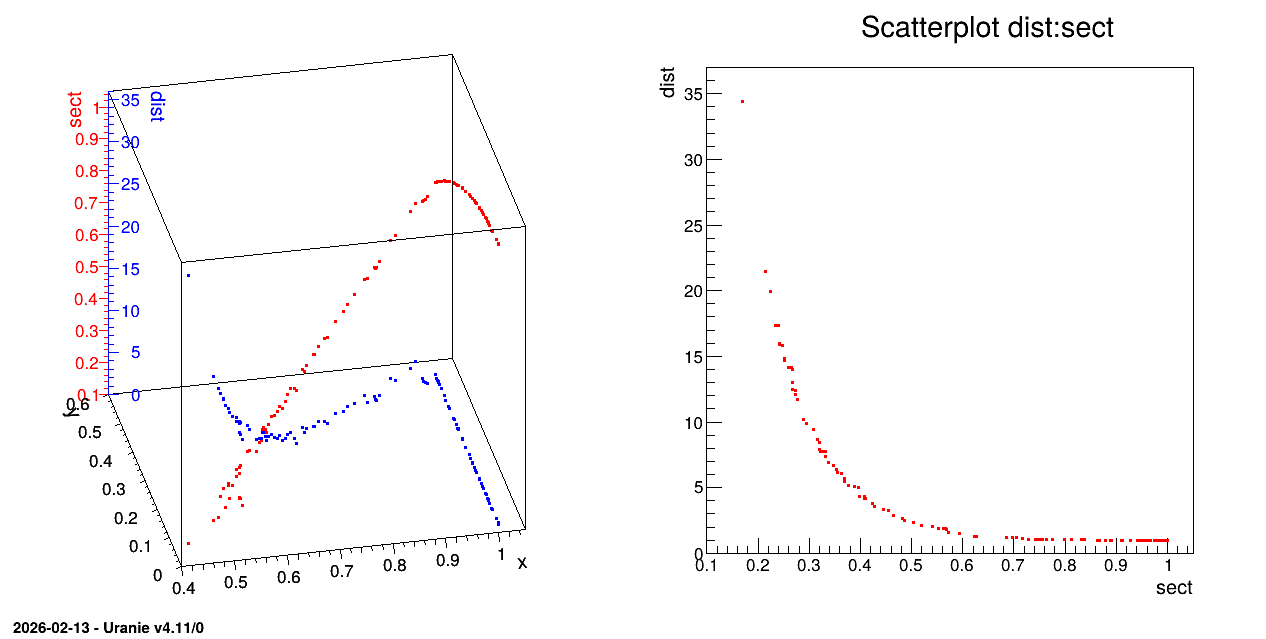
Finally the optimisation is launched and the rest of code is providing the graphical result shown in next section.
13.8.3.3. Graph
Figure 13.56 Graph of the macro “reoptimizeHollowBarCodeVizir.C”