13.3.15. Macro “dataserverDrawQQPlot.py”
13.3.15.1. Objective
This macro is an example of how to produce QQ-plot for a certain number of randomly-drawn samples, providing the correct parameter values along with modified versions to illustrate the impact.
13.3.15.2. Macro Uranie
"""
Example of QQ plot
"""
from URANIE import DataServer, Sampler
import ROOT

# Create a TDS with 8 kind of distributions
p1 = 1.3
p2 = 4.5
p3 = 0.9
p4 = 4.4  # Fixed values for parameters

tds0 = DataServer.TDataServer()
tds0.addAttribute(DataServer.TNormalDistribution("norm", p1, p2))
tds0.addAttribute(DataServer.TLogNormalDistribution("logn", p1, p2))
tds0.addAttribute(DataServer.TUniformDistribution("unif", p1, p2))
tds0.addAttribute(DataServer.TExponentialDistribution("expo", p1, p2))
tds0.addAttribute(DataServer.TGammaDistribution("gamm", p1, p2, p3))
tds0.addAttribute(DataServer.TBetaDistribution("beta", p1, p2, p3, p4))
tds0.addAttribute(DataServer.TWeibullDistribution("weib", p1, p2, p3))
tds0.addAttribute(DataServer.TGumbelMaxDistribution("gumb", p1, p2))

# Create the sample
fsamp = Sampler.TBasicSampling(tds0, "lhs", 200)
fsamp.generateSample()

# Define number of laws, their name and numbers of parameters
nLaws = 8
# number of parameters to put in () for the corresponding law
laws = ["normal", "lognormal", "uniform", "gamma", "weibull",
        "beta", "exponential", "gumbelmax"]
npar = [2, 2, 2, 3, 3, 4, 2, 2]

# Create the canvas
c = ROOT.TCanvas("c1", "", 800, 1000)
# Create the 8 pads
apad = ROOT.TPad("apad", "apad", 0, 0.03, 1, 1)
apad.Draw()
apad.cd()
apad.Divide(2, 4)

# Number of points to compare theoretical and empirical values
nS = 1000
mod = 0.8  # Factor used to artificially change the parameter values

Par = lambda i, n, p, mod: "," + str(p*mod) if n >= i else ""
opt = ""  # option of the drawQQPlot method
for i in range(nLaws):

    # Clean sstr
    test = ""
    # Add nominal configuration
    test += laws[i] + "(" + str(p1) + "," + str(p2) + Par(3, npar[i], p3, 1) \
        + str(p2) + Par(4, npar[i], p4, 1) + ")"
    # Changing par1
    test += ":" + laws[i] + "(" + str(p1*mod) + "," + str(p2) \
        + Par(3, npar[i], p3, 1) + str(p2) + Par(4, npar[i], p4, 1) + ")"
    # Changing par2
    test += ":" + laws[i] + "(" + str(p1) + "," + str(p2*mod) \
        + Par(3, npar[i], p3, 1) + str(p2) + Par(4, npar[i], p4, 1) + ")"
    # Changing par3
    if npar[i] >= 3:
        test += ":" + laws[i] + "(" + str(p1) + "," + str(p2) \
            + Par(3, npar[i], p3, mod) + str(p2) + Par(4, npar[i], p4, 1) + ")"
    # Changing par4
    if npar[i] >= 4:
        test += ":" + laws[i] + "(" + str(p1) + "," + str(p2) \
            + Par(3, npar[i], p3, 1) + str(p2) + Par(4, npar[i], p4, mod) + ")"

    apad.cd(i+1)
    # Produce the plot
    tds0.drawQQPlot(laws[i][:4], test, nS, opt)
The very first step of this macro is to create a sample that will contain a design-of-experiments filled with 200
locations, using various statistical laws. All the tested laws, are those available in the drawQQPlot
method and they might depend on 2 to 4 parameters, defined a but randomly at the beginning of this
piece of code.
# Create a TDS with 8 kind of distributions
p1 = 1.3
p2 = 4.5
p3 = 0.9
p4 = 4.4  # Fixed values for parameters

tds0 = DataServer.TDataServer()
tds0.addAttribute(DataServer.TNormalDistribution("norm", p1, p2))
tds0.addAttribute(DataServer.TLogNormalDistribution("logn", p1, p2))
tds0.addAttribute(DataServer.TUniformDistribution("unif", p1, p2))
tds0.addAttribute(DataServer.TExponentialDistribution("expo", p1, p2))
tds0.addAttribute(DataServer.TGammaDistribution("gamm", p1, p2, p3))
tds0.addAttribute(DataServer.TBetaDistribution("beta", p1, p2, p3, p4))
tds0.addAttribute(DataServer.TWeibullDistribution("weib", p1, p2, p3))
tds0.addAttribute(DataServer.TGumbelMaxDistribution("gumb", p1, p2))
Once done, the sample is generated using TBasicSampling object with an LHS algorithm. On top of
this, despite the plot preparation with canvas and pad generation, several variables are set to
prepare the tests, as shown below
# Define number of laws, their name and numbers of parameters
nLaws = 8
# number of parameters to put in () for the corresponding law
laws = ["normal", "lognormal", "uniform", "gamma", "weibull",
        "beta", "exponential", "gumbelmax"]
npar = [2, 2, 2, 3, 3, 4, 2, 2]

# Number of points to compare theoretical and empirical values
nS = 1000
mod = 0.8  # Factor used to artificially change the parameter values
Finally, after the line of hypothesis to be tested is constructed (the first paragraph in the for
loop) the drawQQPlot method is called for every empirical law in the following line.
tds0.drawQQPlot(laws[i][:4], test, nS, opt)
For the first case, when one wants to test the TNormalDistribution “norm” with the known parameters
and a variation of each, it resumes as if this line was run:
tds0.drawQQPlot( "norm", "normal(1.3,4.5):normal(1.04,4.5):normal(1.3,3.6)", nS)
The first field is the attribute to be tested, while the second one provides the three hypothesis with which our attribute under investigation will be compared. The third argument is the number of steps to be computed for quantiles.
The result of this macro is shown below.
13.3.15.3. Graph
Figure 13.7 Graph of the macro 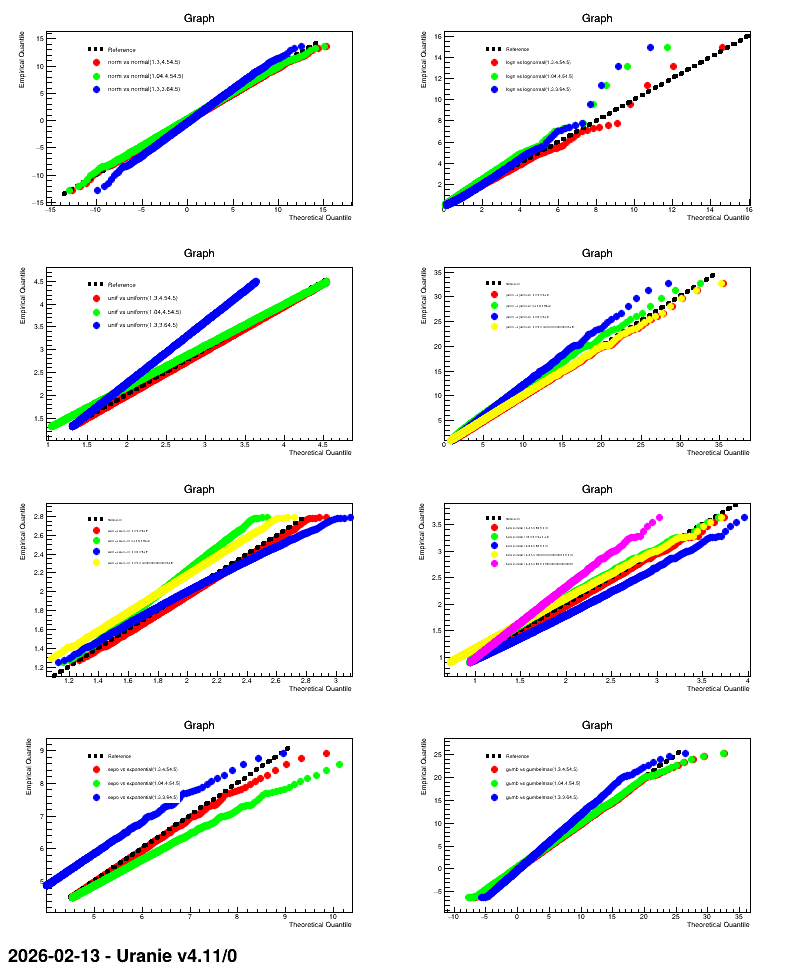
"dataserverDrawQQPlot.py"