2.1.1.17. Student Law
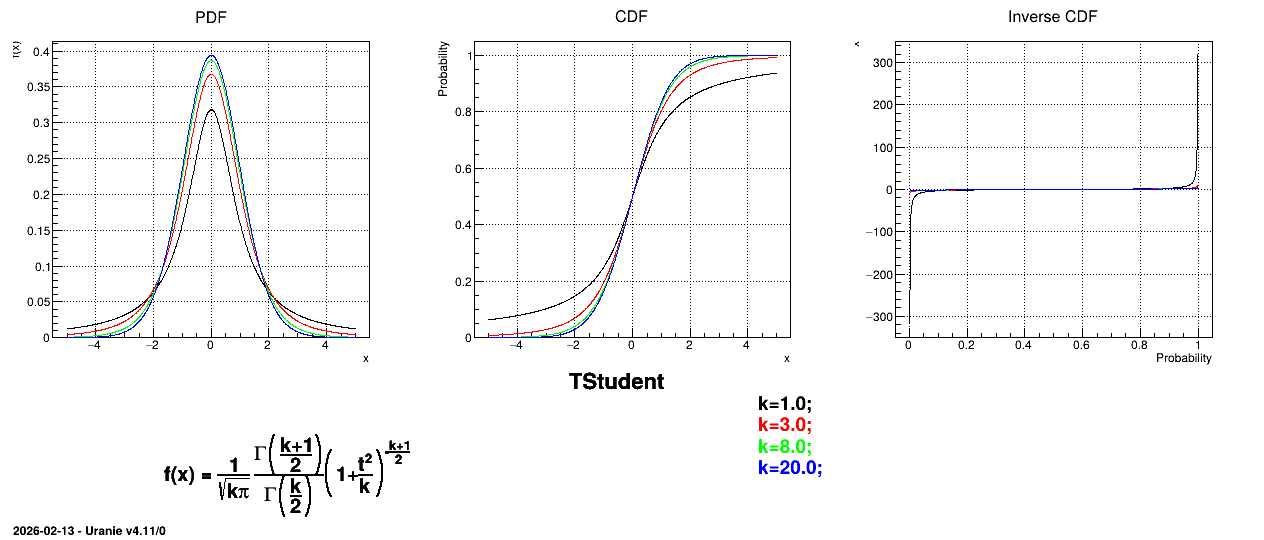
The Student law is simply defined with a single parameter: the degree-of-freedom (DoF). The probability density function is then set as
where \(\Gamma\) is the Euler’s gamma function.
This distribution is famous for the t-test, a test-hypothesis developed by Fisher to check validity of the null hypothesis when the variance is unknown and the number of degree-of-freedom is limited. Indeed, when the number of degree-of-freedom grows, the shape of the curve looks more and more like the centered-reduced normal distribution. The mean value of the student law is 0 as soon as \(k > 1\) (and is not determined otherwise). Its variance can be written as \(\sigma^2=\frac{k}{k-2}\) as soon as \(k > 2\), infinity if \(1 < k \leq 2\), and is not determined otherwise.
Figure 2.18 shows the PDF, CDF and inverse CDF generated for different sets of parameters.
Figure 2.18 Example of PDF, CDF and inverse CDF for Student distributions.