2.1.1.7. Trapezium law
This law describes a trapezium whose large base is defined between a minimum and a maximum and its small base lies between a low and an up value, as
where \(Y=1 \; {\rm for} \; x \in [x_{\rm low},x_{\rm up}]\), \(Y=\dfrac{(x - x_{\rm min})}{(x_{\rm low} - x_{\rm min})} \; {\rm for}\; x \in [x_{\rm min},x_{\rm low}]\) and \(Y=\dfrac{(x_{\rm max} - x)}{(x_{\rm max} - x_{\rm up})} \; {\rm for} \; x \in [x_{\rm up},x_{\rm max}]\).
For this distribution, the mean can be estimated through \(\mu = \frac{1}{3(x_{\rm max} + x_{\rm up} - x_{\rm low} - x_{\rm min})} \bigg( \frac{x^3_{\rm max} - x^3_{\rm up}}{x_{\rm max} - x_{\rm up}} - \frac{x^3_{\rm low} - x^3_{\rm min}}{x_{\rm low} - x_{\rm min}} \bigg)\) while the variance is \(\sigma^2 = \frac{1}{6(x_{\rm max} + x_{\rm up} - x_{\rm low} - x_{\rm min})} \bigg( \frac{x^4_{\rm max} - x^4_{\rm up}}{x_{\rm max} - x_{\rm up}} - \frac{x^4_{\rm low} - x^4_{\rm min}}{x_{\rm low} - x_{\rm min}} \bigg) - \mu^2\). The mode is not properly defined as all probability are equals in \([x_{\rm low}, x_{\rm up}]\)
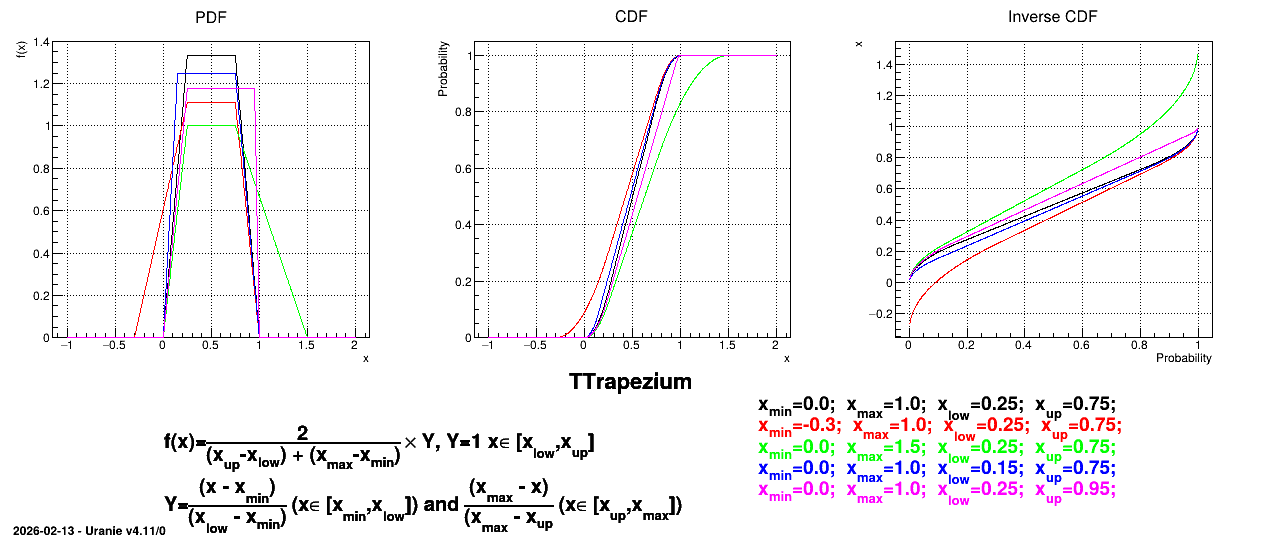
Figure 2.8 shows the PDF, CDF and inverse CDF generated for different sets of parameters.
Figure 2.8 Example of PDF, CDF and inverse CDF for Trapezium distributions.