2.1.1.1. Uniform Law
The Uniform law is defined between a minimum and a maximum, as
\[f(x)= \frac{1}{(x_{\rm max}-x_{\rm min})}{\rm 1\kern-0.28emI}_{[x_{\rm min},x_{\rm max}]}(x)\]
The property of the law lies on the fact that all points of the interval \([x_{\rm min},x_{\rm max}]\) have the same probability. The mean value of the uniform law can then be computed as \(\mu=\frac{x_{\rm max} + x_{\rm min}}{2}\) while its variance can be written as \(\sigma^2 = \frac{(x_{\rm max} - x_{\rm min})^2}{12}\). The mode is not really defined as all points have the same probability.
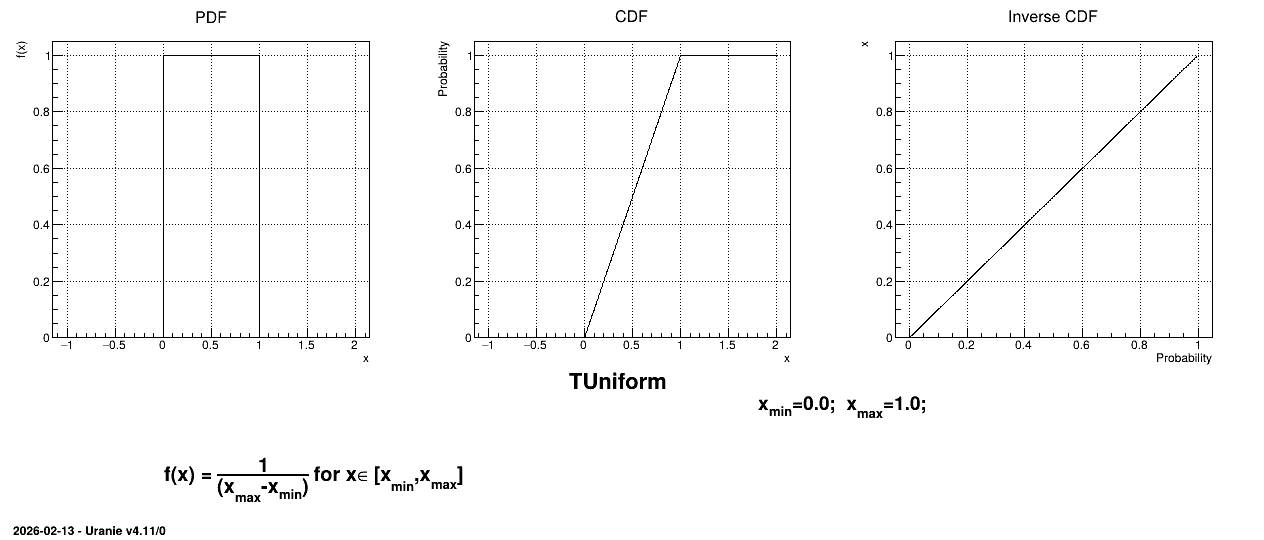
Figure 2.2 shows the PDF, CDF and inverse CDF generated for a given set of parameters.
Figure 2.2 Example of PDF, CDF and inverse CDF for Uniform distributions.