2.1.1.2. Log Uniform Law
The LogUniform law is well adapted for variations of high amplitudes. If a random variable \(x\) follows a LogUniform distribution, the random variable \(\ln(x)\) follows a Uniform distribution, so
From the statistical point of view, the mean value of the LogUniform law can then be computed as \(\mu=\dfrac{x_{\rm max} - x_{\rm min}}{\ln(x_{\rm max}/x_{\rm min})}\) while its variance can be written as \(\sigma^2=\frac{x_{\rm max}^2-x_{\rm min}^2}{2\ln(x_{\rm max}/x_{\rm min})} - \big( \frac{x_{\rm max}-x_{\rm min}}{\ln(x_{\rm max}/x_{\rm min})} \big)^2\). By definition, the mode is equal to \(x_{\rm min}\).
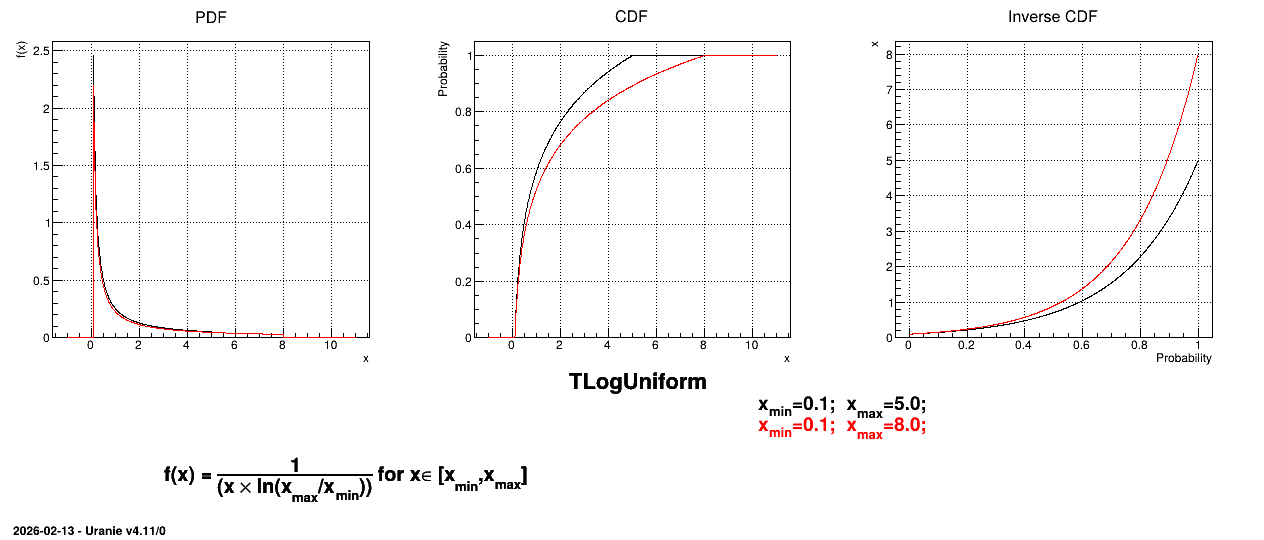
Figure 2.3 shows the PDF, CDF and inverse CDF generated for different sets of parameters.
Figure 2.3 Example of PDF, CDF and inverse CDF for LogUniform distributions.