2.2.5.3. Triangular Law
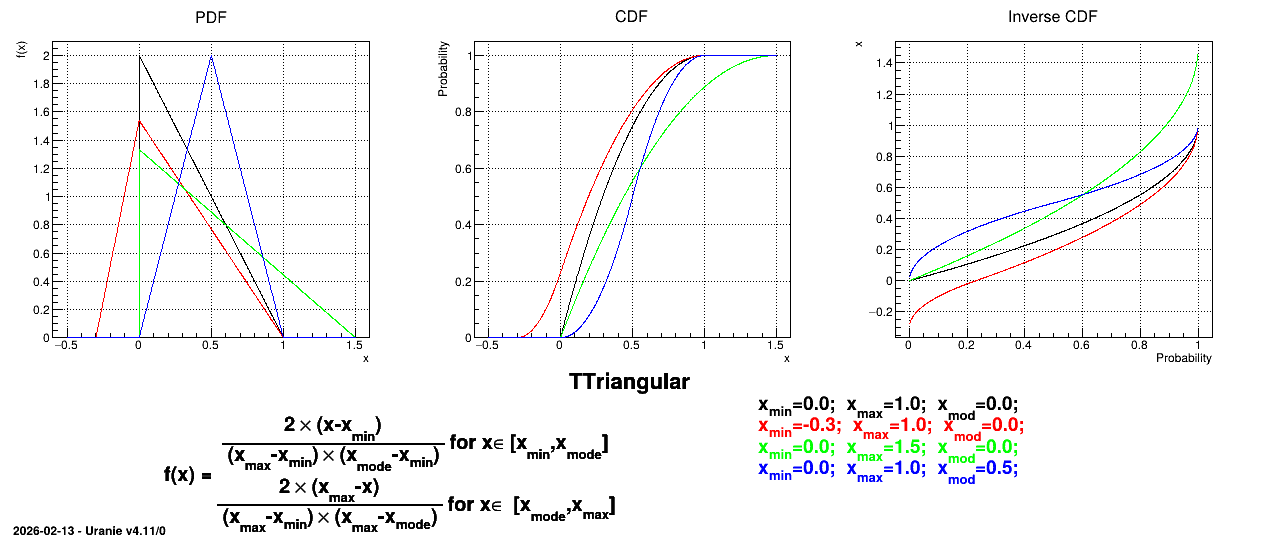
This law describes a triangle with a base between a minimum and a maximum and a highest density at a certain point \(x_{\rm mode}\), so
\[f(x) = \frac{2 \times (x-x_{\rm min})}{ (x_{\rm max}-x_{\rm min}) \times
(x_{\rm mode}-x_{\rm min}) } {\rm 1\kern-0.28emI}_{[x_{\rm min}, x_{\rm mode}]}(x)\]
and
\[f(x) = \frac{2 \times (x_{\rm max}-x)}{ (x_{\rm max}-x_{\rm min}) \times
(x_{\rm max}-x_{\rm mode}) } {\rm 1\kern-0.28emI}_{[x_{\rm mode},x_{\rm max}]}(x)\]
Uranie code to simulate a triangular random variable is:
    TDataServer *tds = new TDataServer("tdssampler", "Sampler Uranie demo");
    tds->addAttribute( new TTriangularDistribution("t", 5.0, 8., 6.0));

    TSampling *fsamp = new TSampling(tds, "lhs", 300);
    fsamp->generateSample(); // Create a representative sample

    tds->Draw("t");
Figure 2.7 shows the PDF, CDF and inverse CDF generated for different sets of parameters.
Figure 2.7 Example of PDF, CDF and inverse CDF for Triangular distributions.