2.3.6. Pattern selection
It can be necessary during a study to apply filters on the patterns; i.e. to include or to exclude
patterns depending on criterion. For example, to select the patterns with x1 lower than 3.0 and x2
lower than 55.0 from the geyser database, Uranie code is as follows:
    tdsGeyser->setSelect("( x1<3.0 ) & ( x2<55.)");
    tdsGeyser->draw("x2:x1");
The obtained figure is:
Figure 2.40 Graph with a selection definition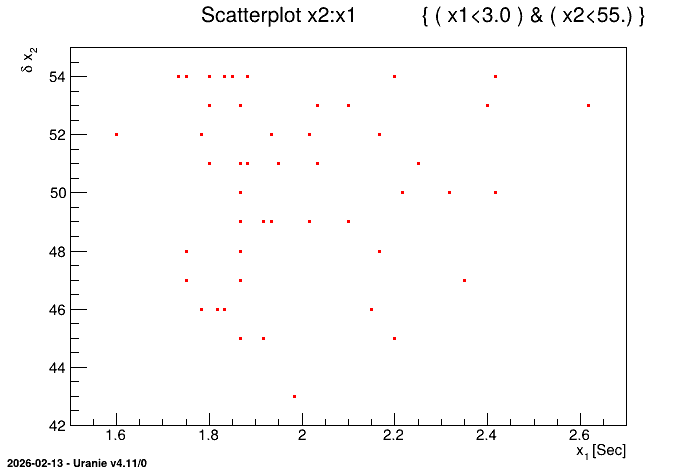
The result of the scan method applied on this TDataServer object yields:
************************************************
*    Row   *        x1 *        x2 * n__iter__ *
************************************************
*        1 *       1.8 *        54 *         2 *
*        8 *      1.95 *        51 *         9 *
*       10 *     1.833 *        54 *        11 *
*       13 *      1.75 *        47 *        14 *
*       15 *     2.167 *        52 *        16 *
...
*      268 *      2.15 *        46 *       269 *
*      270 *     1.817 *        46 *       271 *
************************************************
==> 53 selected entries
We have obtained 53 patterns among 278 respecting the given criterion without having to specify this
criterion for the draw and scan calls. To get the same result, we could have executed the following
command as well:
    tdsGeyser->draw("x2:x1", "( x1<3.0 ) && ( x2<55.)");
    //tdsGeyser->scan("*", "( x1<3.0 ) && ( x2<55.)");
However, in this case, we have to repeat the criterion for each command.
It is also possible to exclude patterns coming from TDataServer with the setCut method.
    tdsGeyser->setCut(TString("x1 >= 3."));
    tdsGeyser->draw("x2:x1");
The obtained figure is as follows:
Figure 2.41 Graph with a definition of Cut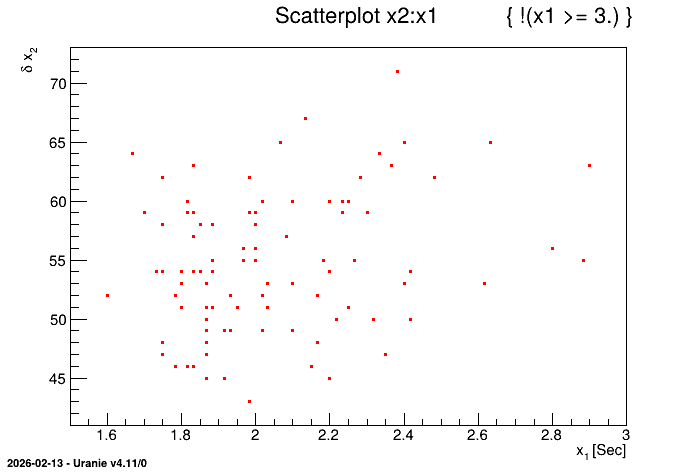
It can be noticed in the title of Figure 2.41, that it simply
corresponds to the opposite of criterion’s meaning with respect to the one given by the setCut
method with the ! ( ) character. Thus, the setCut method consists in passing on the negation
of the criterion to the setSelect command.
Finally, it is perfectly possible to delete the current filters with the methods clearSelect and
clearCut, and retrieving the unfiltered results.
Tip
Every modifications of the ongoing selection (meaning doing a new selection or removing it) is now clearing automatically the vectors that contain statistical properties of attributes and the database of already computed quantiles. This is reminded with an information line shown below:
<URANIE::INFO> Selection is changing ==> clearing the TAttribute computed statistics and quantiles
Summary: Filters management regarding patterns
setSelect( TString sselect)Patterns selection ensuring the criterion sselect
setCut( TString scut)Excluding the patterns ensuring the criterion scut
clearSelect() /clearCut()Deletes the current filter.
Any modification of the selection is now clearing the vector of statistic (mean, std, min and max) introduced in List of variable information as well as the map containing quantiles. This is done in order to be sure that the method used to performed these estimation are called once again to take into account the change in selection. An informative message is displayed to remind this clearing.