2.2.5.6. LogNormal law
If a random variable \(x\) follows a LogNormal distribution, the random variable \(\ln(x)\) follows a Normal distribution (whose parameters are \(\mu\) and \(\sigma\)), so
In Uranie, it is parametrised by default using \(M\), the mean of the distribution, \(E_{f}\), the Error factor that represents the ration of the 95% quantile and the median (\(E_{f} = q_{0.95} / q_{0.50}\)) and the minimum \(x_{\rm min}\). One can go from one parametrisation to the other following those simple relations
Uranie code to simulate a LogNormal random variable is:
tds = DataServer.TDataServer("tdssampler", "Sampler Uranie demo")
# using M, Ef and xmin
tds.addAttribute(DataServer.TLogNormalDistribution("ln", 1.2, 1.5, -0.5))
# to use ln(x) properties:
# mu = 0.5
# sigma = 1
# tds.setUnderlyingNormalParameters(mu,sigma)

fsamp = Sampler.TSampling(tds, "lhs", 300)
fsamp.generateSample()  # Create a representative sample

tds.Draw("ln")
tds.Draw("log(ln)")  # Check that ln(ln) follows a normal law
Figure 2.11 shows the PDF, CDF and inverse CDF generated for different sets of parameters.
Figure 2.11 Example of PDF, CDF and inverse CDF for LogNormal distributions.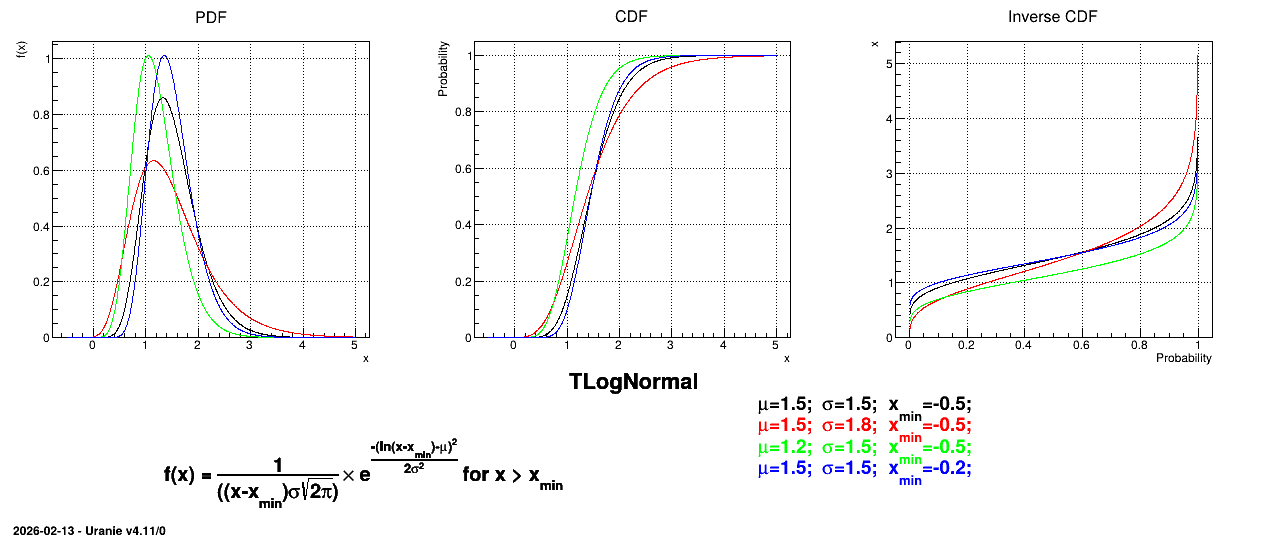
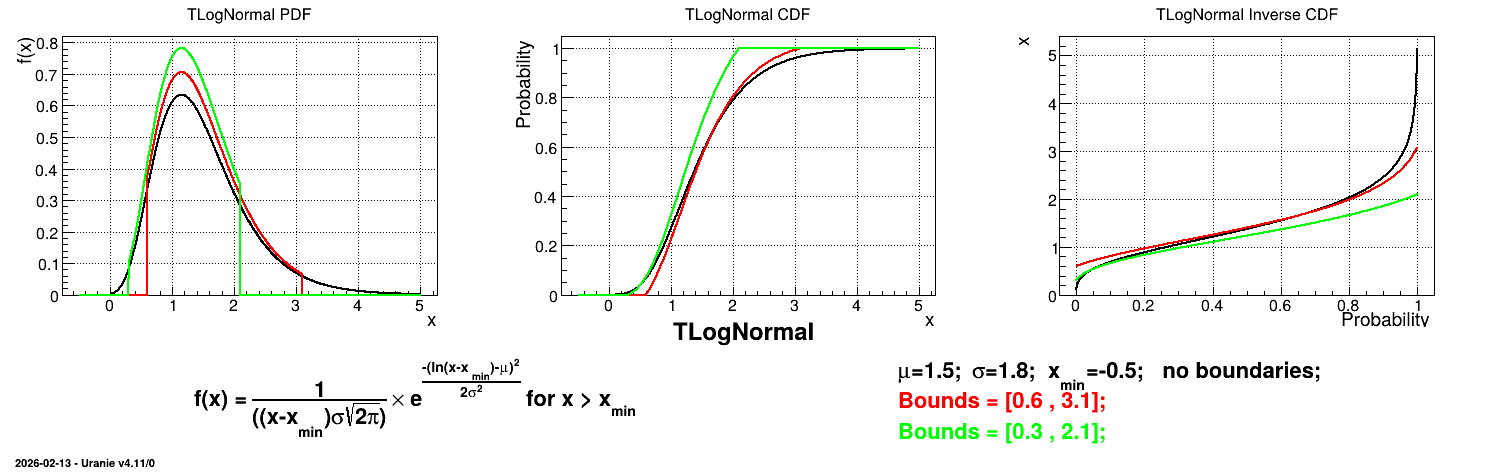
Is it also possible to set boundaries to the infinite span of this distribution to create a truncated normal law. This can be done by calling the following method:
tds.getAttribute("ln").setBounds(0.6,3.1) # truncate the law
The resulting PDF, CDF and inverse CDF, with and without truncation, can be seen, in this case, in Figure 2.12 for a given set of parameters and various boundaries.
Figure 2.12 Example of PDF, CDF and inverse CDF for a LogNormal truncated distribution.