


Documentation
/ Guide méthodologique
: 
| VII.6. CIRCE method | ||
|---|---|---|
 | Chapter VII. The Calibration module |  |
The CIRCE method is a statistical approach proposed as an alternative to expert judgement, designed to determine the uncertainty of parameters in a physical model. Such uncertainties are often difficult to assess because some parameters may not be directly measurable. However, by relying on separate-effect tests (SET) experiments, that are sensitive to the physical model, it becomes possible to infer estimates of these uncertainties.
As already stated, CIRCE (which stands for "Calcul des Incertitudes Relatives aux Correlations Elementaires") is a
statistical method in which the uncertainties are defined through random variables, mean values and standard deviations
[Circe,DeCrecy01]. Usually, if one considers  the unobserved parameters (
 being the number of these parameters, limited here to a certain number
 ), one can write the following
equation
), one can write the following
equation

Each physical parameter is expressed as a function of a
nominal value ( ) and a multiplier coefficient
  . A relation can be constructed between these multipliers and the parameters considered by CIRCE, as

The nominal value of  is set to 0 (which implies that the nominal value of the influential physical model
is equal to 1). The other inputs needed by the method are the observed data (or responses) hereafter referred to as
is set to 0 (which implies that the nominal value of the influential physical model
is equal to 1). The other inputs needed by the method are the observed data (or responses) hereafter referred to as
 (
( being a realisation of the SET experiment), and
the corresponding code result
being a realisation of the SET experiment), and
the corresponding code result  . CIRCE combines the difference between the experimental results and the code predictions (
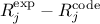 ) with the
derivatives of each code response with respect to each parameter
) with the
derivatives of each code response with respect to each parameter  . It is
also possible to take into account the experimental uncertainties of the response, called hereafter
. It is
also possible to take into account the experimental uncertainties of the response, called hereafter  . This procedure should
lead to the estimation, for every
. This procedure should
lead to the estimation, for every  parameter, of its mean value
  (for bias) and its standard deviation,
  .
.
In order to perform this estimation, there are two main hypotheses done by the CIRCE method:
the linearity between the code response and each parameter
. This hypothesis is clearly visible since first-order derivatives
are used for the estimation . It is further discussed in Section VII.6.1.1.
the normality of the
parameters. A hypothesis on the PDF of CIRCE parameters is indeed compulsory, leading to the
hypothesis of normality or lognormality of the multiplier if the additive or exponential change of variable is
used in Equation VII.14. This is further discussed in Section VII.6.1.2.
For every response, the quantity of interest is which can also be written as, if
 denotes
the real value of the response
denotes
the real value of the response  ,
,
 . It is the sum of
two independent random variables:
. It is the sum of
two independent random variables:
(
 ): the experimental uncertainty which follows a centered normal distribution of known
standard deviation
): the experimental uncertainty which follows a centered normal distribution of known
standard deviation  .
.
(
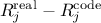 ): which is obtained from a first-order development as
In this definition,
 is the unknown value assigned to the i-th parameter such that
 ( being different for every response) and
 is the nominal value of this i-th parameter (generally 0).
If we collect all the information about the system described so far, the problem can be summarised as

In this expression, one can discuss the different contributions:
- and are known.
 is a realisation of
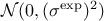 where is also known.
The
are
unknown. The only available information comes from their statistical properties: their bias
and their standard
deviation .
Several solutions are possible for the vector  , leading to a needed choice among them. The criterion chosen to do so is
the maximum likelihood estimation, which requires a hypothesis on the form of the probability distribution
followed by the
parameters. The normality assumption is then adopted.
, leading to a needed choice among them. The criterion chosen to do so is
the maximum likelihood estimation, which requires a hypothesis on the form of the probability distribution
followed by the
parameters. The normality assumption is then adopted.
| |  | |
| VII.5. Markov chain Monte Carlo approach |  | Chapter VIII. The Uncertainty modeler module |