13.8.6. Macro “relauncherCodeFlowrateMPI.py”
13.8.6.1. Objective
The goal of this macro is to show how to handle a code run on several threads with another memory
paradigm: when the TThreadedRun instance is relying on shared memory (leading to possible
thread-safe problem, as discussed in TThreadedRun), the MPI implementation is
based on the separation of the memory. The communication is made through messages. In order to this,
the usual sequential runner will be removed and another runner will be called to do the job. The
flowrate code is provided with Uranie and has been also used and discussed throughout these
macros.
13.8.6.2. Macro
"""
Example of MPi usage for code launching
"""
from URANIE import DataServer, Relauncher, MpiRelauncher
import ROOT

# Create input attributes
rw = DataServer.TAttribute("rw")
r = DataServer.TAttribute("r")
tu = DataServer.TAttribute("tu")
tl = DataServer.TAttribute("tl")
hu = DataServer.TAttribute("hu")
hl = DataServer.TAttribute("hl")
lvar = DataServer.TAttribute("l")
kw = DataServer.TAttribute("kw")

# Create the output attribute
yhat = DataServer.TAttribute("yhat")
d = DataServer.TAttribute("d")

# Set the reference input file and the key for each input attributes
fin = Relauncher.TFlatScript("flowrate_input_with_values_rows.in")
fin.addInput(rw)
fin.addInput(r)
fin.addInput(tu)
fin.addInput(tl)
fin.addInput(hu)
fin.addInput(hl)
fin.addInput(lvar)
fin.addInput(kw)

# The output file of the code
fout = Relauncher.TFlatResult("_output_flowrate_withRow_.dat")
fout.addOutput(yhat)
fout.addOutput(d)  # Passing the attributes to the output file

# Instanciation de mon code
mycode = Relauncher.TCodeEval("flowrate -s -r")
# mycode.setOldTmpDir()
mycode.addInputFile(fin)
mycode.addOutputFile(fout)

# Create the MPI runner
run = MpiRelauncher.TMpiRun(mycode)
run.startSlave()
if run.onMaster():

    # Define the DataServer
    tds = DataServer.TDataServer("tdsflowrate",
                                 "Design of Experiments for Flowrate")
    mycode.addAllInputs(tds)
    tds.fileDataRead("flowrateUniformDesign.dat", False, True)

    lanceur = Relauncher.TLauncher2(tds, run)

    # resolution
    lanceur.solverLoop()

    tds.exportData("_output_testFlowrateMPI_py_.dat")

    ROOT.SetOwnership(run, True)
    run.stopSlave()
Here the first difference when comparing this macro to the previous one (see Macro) is the runner creation:
# Create the MPI runner
run = MpiRelauncher.TMpiRun(mycode)
The TThreadedRun object becomes a TMpiRun object whose construction only requests a pointer to
the assessor.
Another line is different as it is specific to the language: because of the way ROOT
and python deal with object destruction (though the garbage collector approach for the latter),
there is problem in the way one of the main key method for MPI treatment MPI_Finalize is called.
To prevent this from happening in python the following line should be added as soon as the runner
object is created:
ROOT.SetOwnership(run, True)
It allows ROOT to destroy the object injected, calling the finalize method in order for every slave to be properly released. Apart from that, the code is very similar, the only difference being the way to call this macro. It should not be run with the usual command:
python relauncherCodeFlowrateMPI.py
Instead, the command line should start with the mpirun command as such:
mpirun -np N python relauncherCodeFlowrateMPI.py
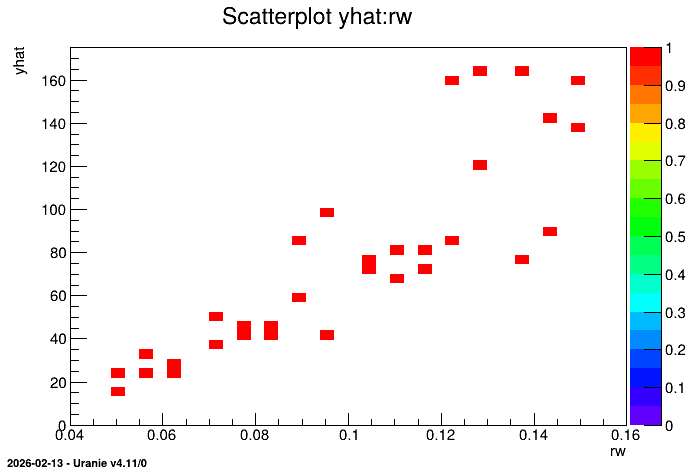
where the N part should be replaced by the number of requested threads. Once run, this macro also leads to the following plots.
Beware never to use the -i argument with the python command line as the macro would never end.
13.8.6.3. Graph
Figure 13.50 Representation of the output as a function of the first input with a colZ option