13.6.6. Macro “sensitivityMorrisFunctionFlowrate.py”
13.6.6.1. Objective
The objective of this macro is to perform a Morris sensitivity analysis on a set of eight parameters
used in the flowrateModel model described in Presentation of the problem.
13.6.6.2. Macro Uranie
"""
Example of Morris estimation on flowrate
"""
from URANIE import DataServer, Sensitivity
import ROOT

ROOT.gROOT.LoadMacro("UserFunctions.C")

# Define the DataServer
tds = DataServer.TDataServer("tdsflowreate", "DataBase flowreate")

tds.addAttribute(DataServer.TUniformDistribution("rw", 0.05, 0.15))
tds.addAttribute(DataServer.TUniformDistribution("r", 100.0, 50000.0))
tds.addAttribute(DataServer.TUniformDistribution("tu", 63070.0, 115600.0))
tds.addAttribute(DataServer.TUniformDistribution("tl", 63.1, 116.0))
tds.addAttribute(DataServer.TUniformDistribution("hu", 990.0, 1110.0))
tds.addAttribute(DataServer.TUniformDistribution("hl", 700.0, 820.0))
tds.addAttribute(DataServer.TUniformDistribution("l", 1120.0, 1680.0))
tds.addAttribute(DataServer.TUniformDistribution("kw", 9855.0, 12045.0))

nreplique = 3
nlevel = 10
scmo = Sensitivity.TMorris(tds, "flowrateModel", nreplique, nlevel)
scmo.setDrawProgressBar(False)
scmo.generateSample()

tds.exportData("_morris_sampling_.dat")
scmo.computeIndexes()

tds.exportData("_morris_launching_.dat")

ntresu = scmo.getMorrisResults()
ntresu.Scan("*")

# Graph
canmoralltraj = ROOT.gROOT.FindObject("canmoralltraj")
can = ROOT.TCanvas("c1", "Graph of sensitivityMorrisFunctionFlowrate",
                   5, 64, 1270, 667)
pad = ROOT.TPad("pad", "pad", 0, 0.03, 1, 1)
pad.Draw()
pad.Divide(2)
pad.cd(1)
scmo.drawSample("", -1, "nonewcanv")
pad.cd(2)
scmo.drawIndexes("mustar", "", "nonewcanv")
The function flowrateModel is loaded from the macro UserFunctions.C (the file can be found in
${URANIESYS}/share/uranie/macros)
ROOT.gROOT.LoadMacro("UserFunctions.C")
Each parameter is related to the TDataServer as a TAttribute and obeys an uniform law on specific interval:
tds = DataServer.TDataServer("tdsflowreate", "DataBase flowreate")
tds.addAttribute(DataServer.TUniformDistribution("rw", 0.05, 0.15))
tds.addAttribute(DataServer.TUniformDistribution("r", 100.0, 50000.0))
tds.addAttribute(DataServer.TUniformDistribution("tu", 63070.0, 115600.0))
tds.addAttribute(DataServer.TUniformDistribution("tl", 63.1, 116.0))
tds.addAttribute(DataServer.TUniformDistribution("hu", 990.0, 1110.0))
tds.addAttribute(DataServer.TUniformDistribution("hl", 700.0, 820.0))
tds.addAttribute(DataServer.TUniformDistribution("l", 1120.0, 1680.0))
tds.addAttribute(DataServer.TUniformDistribution("kw", 9855.0, 12045.0))
To instantiate the TMorris, one uses the TDataServer, the name of the function, the number of replicas
(here nreplique=3), the level parameter (here nlevel=10)
scmo = Sensitivity.TMorris(tds, "flowrateModel", nreplique, nlevel)
Creation of the sampling:
scmo.generateSample()
Data are exported in an ASCII file:
tds.exportData("_morris_sampling_.dat")
Computation of sensitivity indexes:
scmo.computeIndexes()
13.6.6.3. Graph
Figure 13.22 Graph of the macro “sensitivityMorrisFunctionFlowrate.py”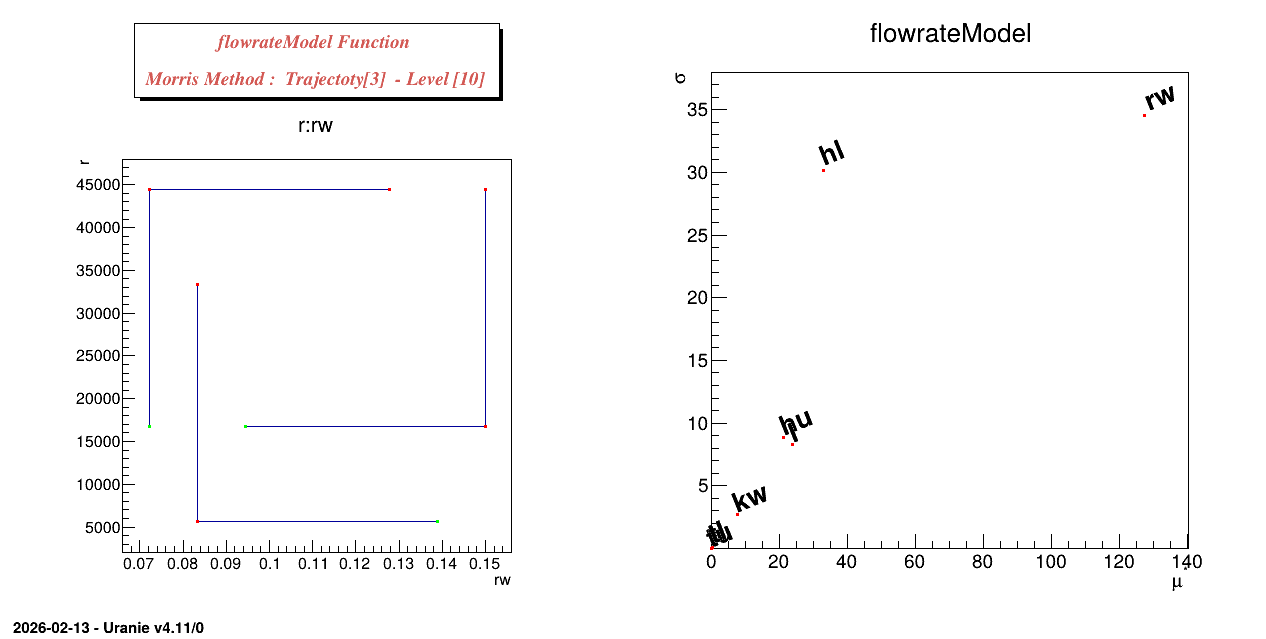
13.6.6.4. Console
************************************************************************
*    Row   *     Input *    Output *     mu.mu * mustar.mu * sigma.sig *
************************************************************************
*        0 *        rw * flowrateM * 127.47900 * 127.47900 * 34.521839 *
*        1 *         r * flowrateM * -0.069601 * 0.0696013 * 0.0793689 *
*        2 *        tu * flowrateM * 0.0004201 * 0.0004201 * 0.0004641 *
*        3 *        tl * flowrateM * 0.4659763 * 0.4659763 * 0.3301256 *
*        4 *        hu * flowrateM * 21.192361 * 21.192361 * 8.8498989 *
*        5 *        hl * flowrateM * -32.74887 * 32.748874 * 30.146134 *
*        6 *         l * flowrateM * -23.89328 * 23.893280 * 8.2781934 *
*        7 *        kw * flowrateM * 7.5766167 * 7.5766167 * 2.7457665 *
************************************************************************